How to Read a Compass
Beginner's Guide to Compass Navigation
Learning how to read a compass is an essential outdoor skill. This beginner-friendly guide teaches you to understand compass parts, find directions, take bearings, and navigate confidently in any environment.
Parts of a Compass
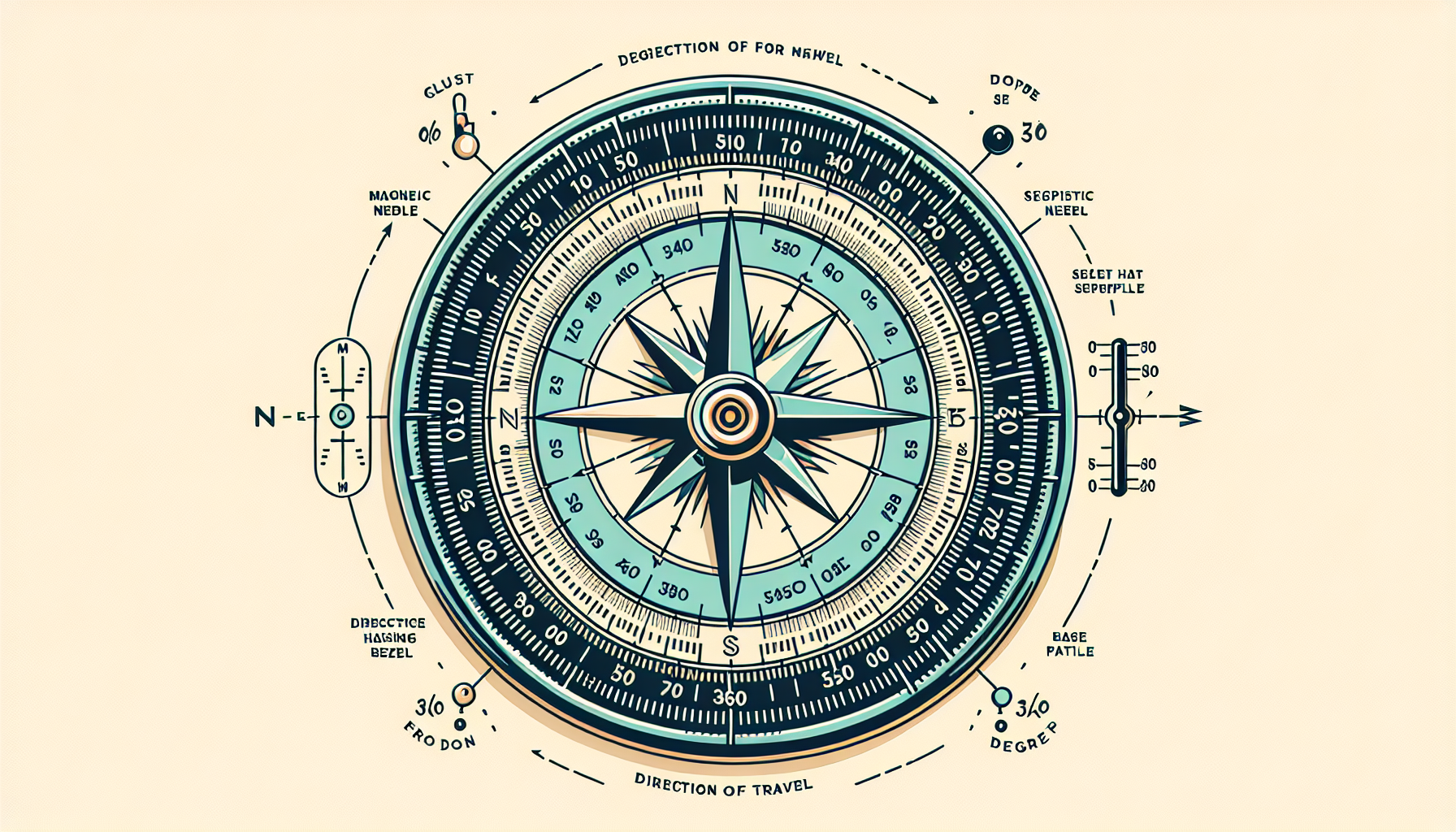
Before reading a compass, understand its components:
- Magnetic Needle: The floating needle that points north (red end = north)
- Compass Housing (Bezel): The rotating dial with degree markings (0-360°)
- Direction-of-Travel Arrow: Fixed arrow on the baseplate showing which way to go
- Orienting Arrow: Arrow or lines inside the housing that you align with the needle
- Baseplate: The transparent plate with rulers for map work
- Index Line: Where you read your bearing on the dial
Step 1: Hold the Compass Correctly
Proper compass technique starts with holding it right:
- Hold the compass flat in your palm at waist height
- Keep it level so the needle can swing freely
- Point the direction-of-travel arrow away from your body
- Keep metal objects and phones away to avoid interference
Step 2: Find North
The simplest compass reading:
- Hold compass flat and let the needle settle
- The red end points to magnetic north
- Rotate your body (not the compass) until the red needle aligns with "N" on the dial
- You're now facing north!
Step 3: Read Your Current Bearing
To know which direction you're currently facing:
- Hold compass flat, direction-of-travel arrow pointing forward
- Let needle settle
- Read the degree number at the index line (where the arrow meets the dial)
- This is your current bearing or heading
Example: If the index line shows 90°, you're facing East.
Step 4: Follow a Specific Bearing
To travel in a specific direction:
- Rotate the compass housing until your desired bearing is at the index line
- Hold the compass flat with the direction-of-travel arrow forward
- Turn your entire body until the red needle sits inside the orienting arrow ("red in the shed")
- Walk in the direction the travel arrow points
Taking a Bearing to a Landmark
To find the direction to a visible object:
- Point the direction-of-travel arrow at the landmark
- Rotate the housing until the orienting arrow aligns with the red needle
- Read the bearing at the index line
- This bearing will lead you back to that landmark
Common Compass Reading Mistakes
- Not holding level: Tilted compass gives false readings
- Metal interference: Phones, belt buckles, and cars affect the needle
- Confusing needle ends: Remember RED = NORTH
- Moving too fast: Let the needle fully settle
- Ignoring declination: Adjust for your area's magnetic variation
Digital vs Traditional Compass
| Feature | Digital (Phone) | Traditional |
|---|---|---|
| Batteries | Required | None needed |
| Accuracy | Varies | Consistent |
| Durability | Fragile | Rugged |
| Calibration | Automatic | Not needed |
| Extra features | GPS, maps | Basic only |
Practice Exercises
- Find all cardinal points: Stand in one spot and face N, E, S, W
- Bearing walk: Walk 50 steps on bearing 90°, then 50 steps on 180°
- Landmark bearings: Take bearings to 5 visible landmarks
- Return bearing: Walk away from home, use opposite bearing to return
Ready to Practice?
Use our free online compass to practice reading bearings on your phone or computer.