Understanding the Compass Rose
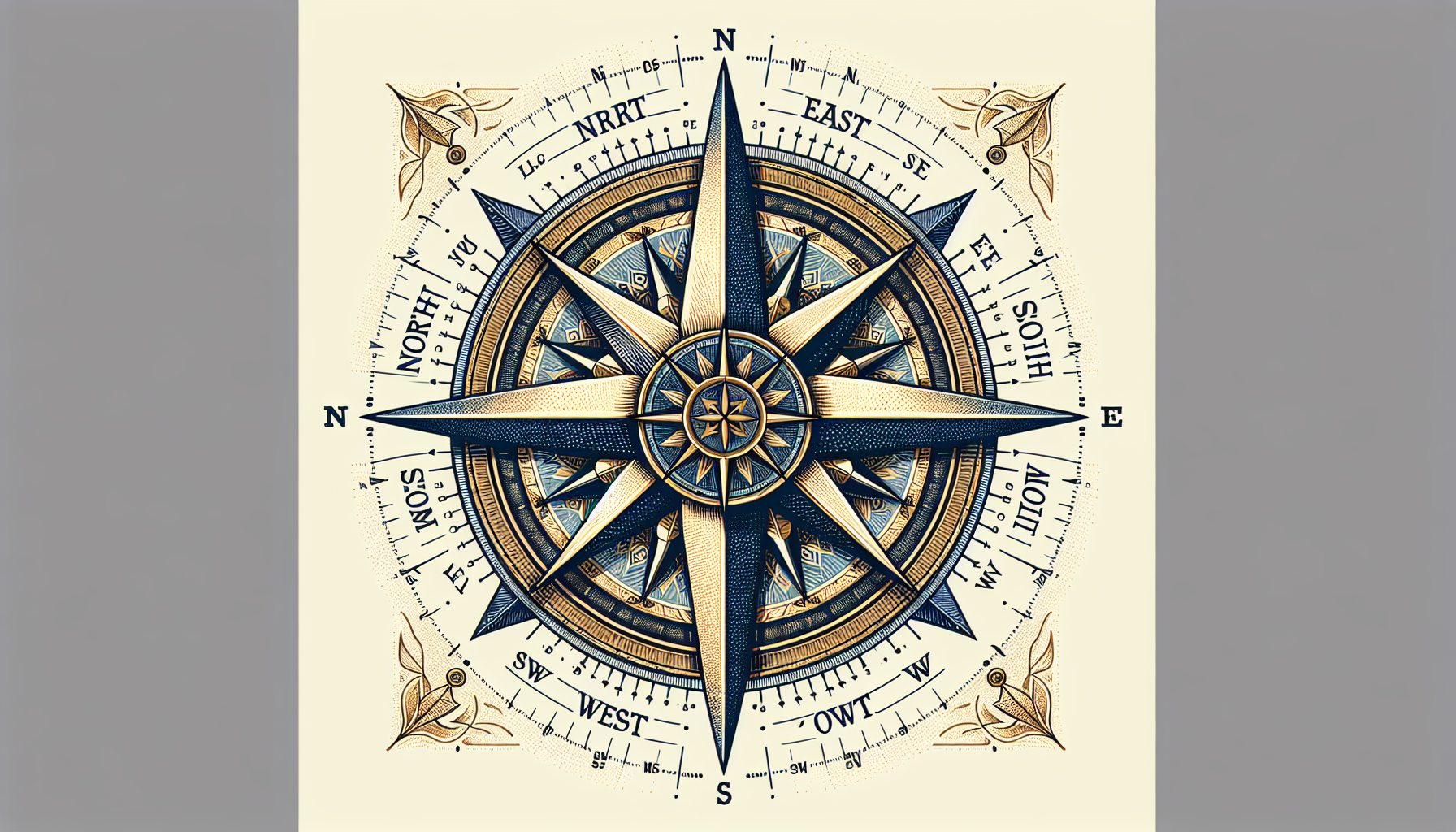
A Complete Guide to Cardinal and Ordinal Directions
The compass rose is the iconic circular diagram showing directions on a compass or map. Learn about cardinal directions, ordinal directions, and how to read compass bearings in degrees.
What is a Compass Rose?
A compass rose, also known as a wind rose, is a figure displaying the orientation of the cardinal directions: North, East, South, and West. Found on compasses, maps, and nautical charts, the compass rose has been an essential navigation tool for centuries.
The name "rose" comes from the decorative appearance of the directional points on historical maps, which resembled the petals of a rose flower.
The Four Cardinal Directions
The primary points on any compass rose:
| Direction | Abbreviation | Degrees |
|---|---|---|
| North | N | 0° (or 360°) |
| East | E | 90° |
| South | S | 180° |
| West | W | 270° |
The Four Ordinal (Intercardinal) Directions
Located between the cardinal points:
| Direction | Abbreviation | Degrees |
|---|---|---|
| Northeast | NE | 45° |
| Southeast | SE | 135° |
| Southwest | SW | 225° |
| Northwest | NW | 315° |
The 16-Point Compass Rose
For more precision, eight additional points are added:
- NNE (North-Northeast) - 22.5°
- ENE (East-Northeast) - 67.5°
- ESE (East-Southeast) - 112.5°
- SSE (South-Southeast) - 157.5°
- SSW (South-Southwest) - 202.5°
- WSW (West-Southwest) - 247.5°
- WNW (West-Northwest) - 292.5°
- NNW (North-Northwest) - 337.5°
The 32-Point Compass Rose
Traditional maritime compass roses have 32 points, each separated by 11.25°. This system was used by sailors before precise degree measurements became common. Each point has a unique name combining cardinal and ordinal directions.
Reading Compass Bearings
Modern navigation uses degrees (0-360°) for precision:
- 0°/360° = Due North
- 90° = Due East
- 180° = Due South
- 270° = Due West
- 45° = Northeast
- 135° = Southeast
Bearings are always measured clockwise from north.
History of the Compass Rose
The compass rose originated in ancient China and was refined by Mediterranean sailors in the 14th century. Early compass roses showed wind directions rather than magnetic directions, which is why they're also called "wind roses."
The Fleur-de-lis symbol traditionally marks north on many compass roses, while a decorative arrow or spear often indicates east (toward the Holy Land for European mapmakers).
Compass Rose in Digital Navigation
Modern digital compasses, including our online compass, display a simplified compass rose with:
- Cardinal points (N, E, S, W)
- Ordinal points (NE, SE, SW, NW)
- Degree markers for precise readings
- Rotating needle or rose indicating current heading
Related Navigation Guides
- Free Online Compass - Try our digital compass
- How to Use a Compass
- Magnetic Declination
- Compass Calibration